

Why Democracy Itself Is A Broken Promise

I am not political junkie. Although, like many of you, these days I’ve been following politics more than ever. We can’t afford not to. Shame on me, though. I’ve realized that I only have a surface-level understanding of how our country should actually work.
This is probably more shameful because, as a lifelong resident of the Washington, DC area, politics is what’s happening in the local news and it’s always been that way. Maybe that’s the problem. Political commentary and government saturate every area of our lives here in the DMV (the District, and Maryland & Virginia suburbs).
I’ve become the fish who doesn’t know it’s swimming in water, because water is everywhere every day. It’s normal. Pretty sure other DMV Kids can relate to that. Especially the government piece.
Growing up, it seemed like everyone’s parents worked for the government.
My friend’s father was one of the Secret Service agents who ushered Ronald Reagan to safety after the former president’s assassination attempt in 1981. My best friend’s father was a top-ranking official at the Department of Agriculture. My own dad was a top weather official at NOAA.
Over the years, I’ve seen Marine One helicopters in the sky and presidential motorcades on the street. Driving in the city, national monuments and federal buildings loom in the background like wallpaper in a dining room.
My sons went to high school with the late Supreme Court Justice Antonin Scalia’s grandson. Our friends’ kids attended school with Malia and Sasha Obama, who we sometimes spotted around town during Barack Obama’s presidency.
Here, political and political-adjacent people are part of an ordinary day, and the signs of democracy are ever-present. But what did I really know about it?
I decided to go all the way back to the founding of our country, the creation of what we’re taught is a democracy. That confirmed a few things. First, I’m more convinced than ever that history repeats itself. A lot. Like, more than I realized. Second, the U.S. Constitution pledged many things when it was ratified back in 1788, but fairness was definitely not one of them.
Some would argue that the framers’ of the Constitution did make an effort to be fair. After all, they intentionally left room for future amendments. They also included some concessions. However, these concessions favored the South, something that still reverberates to this day. So I ask:
Was the U.S. Constitution intended to be a promise? Or a compromise?
Since I’m here to break down the meaning of promises, this is an interesting point: the original Latin word, com-promise (or compromissum) translates to “together promise” or “mutual agreement.”
The modern definition says that both sides give up something in order to reach a shared resolution. Often, it ends up that one party must appease the other. Therefore, a compromise is not necessarily in the best interests of everyone, especially when it affects an entire populace that doesn’t have a say.
That’s precisely what happened when the Constitution was ratified, and although we’re an exceptional country in many ways, we can’t ignore the fact that America’s house was built on morally unstable ground.
The framers did not consider the voices of enslaved Africans, American Indians, poor Whites, and most women. I say most women, because you can’t tell me that wealthy women didn’t influence their husbands. George Washington’s wife, Martha, inherited over 80 enslaved persons from her first husband. She definitely had some sway. But overall, the only voices that were welcomed belonged to White male landowners, many of whom were also enslavers.
When we look at the concessions included in the Constitution, we see that two of them—the Three-Fifths Compromise and the Electoral College—worked in tandem to bolster the voting and economic power of the Southern states by allowing them to wrongly preserve and take advantage of chattel slavery.
The Three-Fifths Compromise came about because the Southern states wanted to include enslaved persons in the overall population count, giving the South more representation and legislative power in Congress.
Now, what’s so insane about this, is that these enslavers did not consider the men, women and children to which they owned (and in many cases, fathered) to be humans. Enslaved people were thought of as property and they had no rights whatsoever.
Dudes, make it make sense. Are they property or people?
Naturally, the Northern states pushed back. Because, hey. If property is part of the population, then from New Hampshire to Georgia, folks should’ve been allowed to count their tables, chairs, oil lamps, and horses. Not that I’m comparing my ancestors to any of those things. I’m trying to make a point as to how ridiculous this was.
Hence, out of this ridiculousness came the Three-Fifths Compromise, whereas five enslaved people were counted as three (each person was considered three-fifths of a person).
The next concession, was the creation of the Electoral College. This body is comprised of each state’s representatives and senators in Congress. Their votes determine who is elected president.
We know that every state, regardless of population, has two senators. However, representatives are based on a state’s population. So, because the Southern states were permitted to add the number of enslaved persons to their total population, this gave those states more political power in Congress.
The Electoral College has proven to favor one political party. Historically, under this system, 6 elected presidents—5 Republicans and 1 from the early-Democratic party (essentially a Republican)—have taken the White House by winning the majority of electoral votes, even though they lost the popular vote.
“The truth is, we have never had a real democracy in America. The framers of the Constitution broke with a European tradition of monarchy and aspired to a revolutionary vision of self-governance, yet they compromised their own ideals from the start. Since then, in the interest of racial subjugation, America has repeatedly attacked its own foundations.” —“The Sum Of Us,” by Heather McGhee
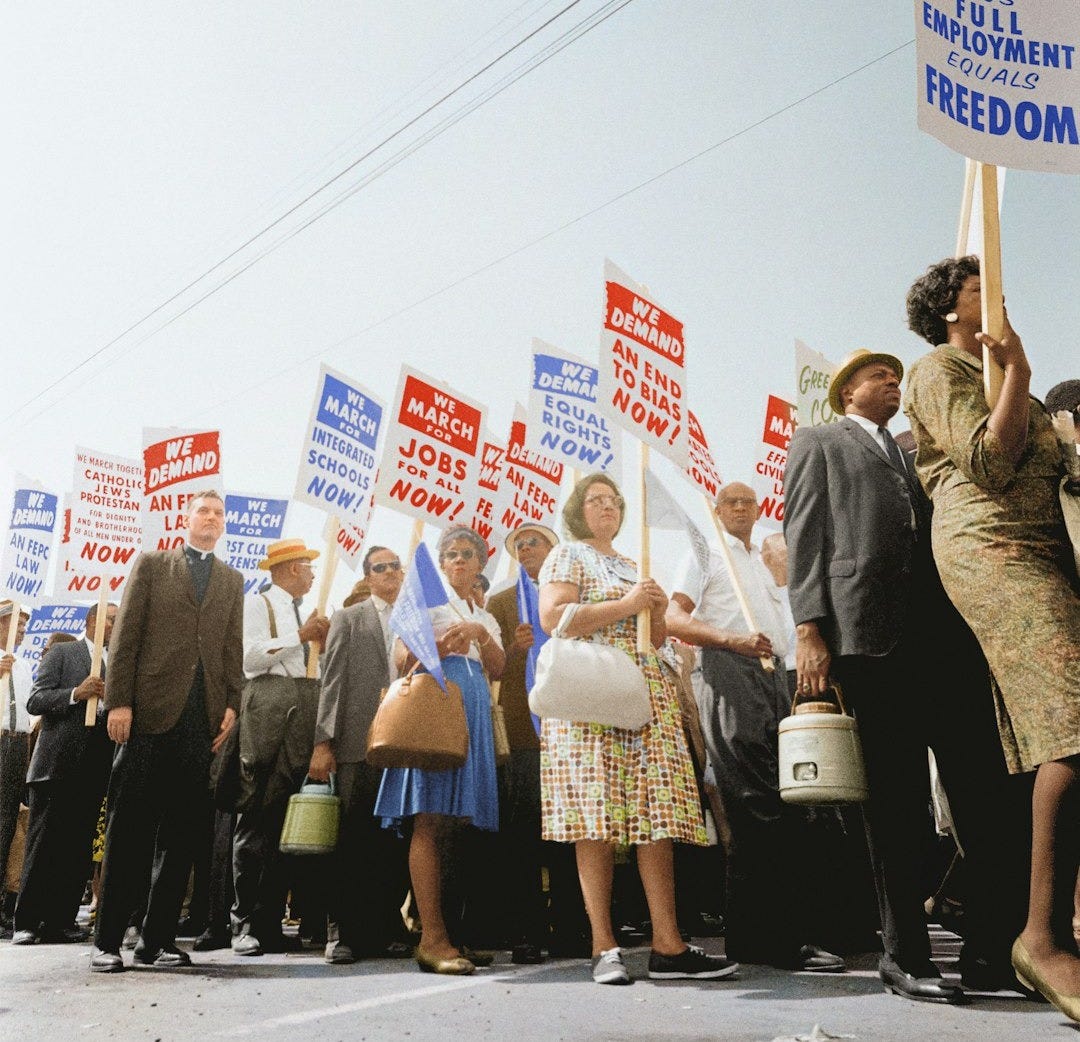
It’s not hard to see what happens when you suppress voices from the start. It certainly colors the history books and fills them with photos of marches, protests, memorable activists, and progressive politicians all struggling to move the country in the right direction.

It also leaves behind blood stains splattered over everything from a small North Carolina town, an entire summer in 1919, and a driveway in Mississippi to the foot of the Edmund Pettus Bridge, a limousine in a presidential motorcade, a balcony at the Lorraine Motel, and a Chicago apartment bedroom.
It forces the people in power to continually justify why certain groups of human beings shouldn’t have full rights. Then they create a caste system and those at the top are offered an inflated view of themselves while everyone else is dehumanized.

The dreams of Brown and Black immigrants are seen as a threat. The “powerful” fear they’re losing power and consolidate it even more. They try to erase and rewrite history. They claim elections were stolen.
They’re willing to take the pillars of America’s democracy, however imperfect and compromised, and burn them to the ground rather than repair and strengthen those pillars by giving everyone a voice.

I don’t know if America will ever live up to its greatest ideals. But I do hope more of us take the time to understand what our country could be—a promise that will one day be fulfilled.
Very well said. I can't imagine the horror of being freed from slavery, having a brief 10 year period of peace, and spending the next 100 years in terror of being lynched. As well as the horror of the Trail of Tears. Being uprooted from your ancestral home to be force marched 2,000 miles to Oklahoma. Seeing land so flat you can see the horizon in all directions. And seeing a tornado the first time and not knowing what it was.